

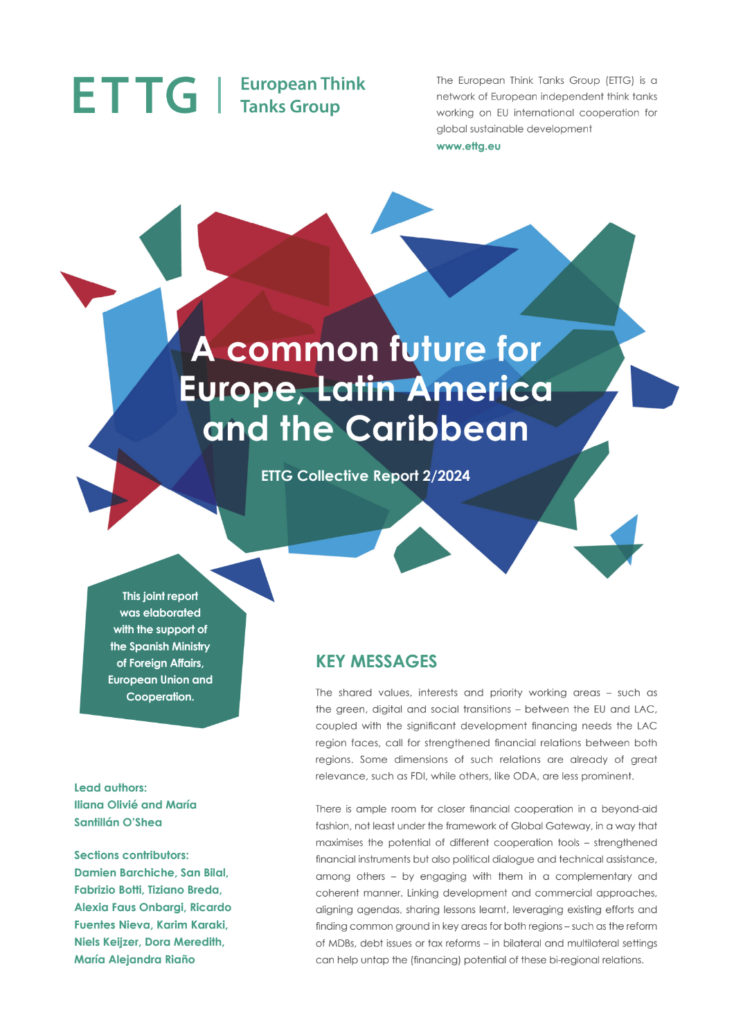
ETTG’s latest collective report, “A common future for Europe, Latin America and the Caribbean,” highlights the shared priorities of both regions, including the green, digital, and social transitions. It emphasises the need for increased financial support for Latin America and the Caribbean, specifically looking beyond traditional aid models.
The report proposes a “beyond-aid” approach that leverages various tools. This includes:
- Strengthened financial instruments: Providing greater access to loans and investments.
- Political dialogue and technical assistance: Facilitating knowledge exchange and capacity building.
- Collaboration in key areas: Addressing shared challenges like reforming multilateral development banks, managing debt, and implementing tax reforms.
The report also identifies opportunities for collaboration in tackling climate change and promoting social inclusion.
- EU-LAC cooperation can focus on mapping existing initiatives, assessing the impact of energy transitions, and mobilising resources.
- Building a robust social protection system is crucial for addressing inequality and strengthening the social contract in Latin America and the Caribbean.
Read the full report and gain insight towards more specific policy recommendations.
Available in English here.
Available in Spanish here.
Picture Credits: Paddle wheel on Balneario Camboriu city beach, Brasil. By Wirestock. Available on iStock.