ettg

COLLECTION

Global Governance Collection

Publications from 2025 – 2026 (onwards)
To be published in early-mid March

About
This Collection

This collection examines how global cooperation is being reshaped in an era of competing visions, transactional diplomacy and shifting power, drawing from ETTG and member research to unpack both the turning points and the emerging rules of the game. Bringing together perspectives from different capitals and thematic fields, it helps readers navigate the move from universal agendas to issue based coalitions, understand how actors in the Global South and Europe are redefining multilateralism in practice, and identify concrete priorities for EU external action, multilateral reform, and the international financial architecture.

Global Governance Collection

The architecture of global cooperation is shifting from a nominally universal, rules‑based order to a more fragmented, competitive landscape shaped by “variable alliances”, multi‑alignment and regional leadership from the Global South. The return of a transactional “America First” doctrine in early 2025, combined with systemic rivalry and the weaponisation of trade and finance, is forcing governments and institutions to re‑think where multilateralism still delivers and where alternative formats are emerging.
For the European Union, this is not simply a question of defending a status quo that no longer exists, it requires a realistic reading of power shifts, a willingness to share decision‑making with emerging actors, and a more strategic use of its economic, regulatory and financial assets.

Multilateralism after Hegemony

ETTG and members’ analyses suggest that the global order is entering a “post‑hegemonic” or “world‑minus‑one” phase, in which multilateral cooperation persists but without a single, stabilising centre of gravity. The 2025 G20 summit in Johannesburg, held without US participation but still able to agree on key elements for debt and climate cooperation, illustrates how coalitions led by South Africa and other emerging powers can sustain multilateral outcomes when traditional hegemons step back.

IDOS work conceptualises the “New Washington Dissensus” as a deliberate break with the 2030 Agenda and SDGs, replacing them with ideologically driven, bilateral deals that weaken shared norms. IAI research on economic statecraft shows how sanctions, export controls and industrial subsidies are increasingly used as tools of power, often with limited attention to knock‑on effects on third countries and multilateral institutions. ECDPM frames the result as a landscape of overlapping, issue‑specific coalitions that require much more diplomatic and analytical bandwidth to navigate. Multilateralism is not collapsing, it is being reconfigured through competing visions of order, development and security.

ECDPM frames the result as a landscape of overlapping, issue‑specific coalitions that require much more diplomatic and analytical bandwidth to navigate. Multilateralism is not collapsing, it is being reconfigured through competing visions of order, development and security.

The Global South and New Coalitions

Elcano’s work on the G20 and global presence highlights the rise of a Global South: heterogeneous actors such as Brazil, India, Indonesia and South Africa that are less interested in joining fixed blocs than in practising calibrated multi‑alignment. ODI Global’s scenarios for the futures of aid underline that, in this setting, development cooperation is pulled between competing visions: from climate‑centred solidarity to transactional, interest‑based deals and more decentralised regional arrangements.
ECDPM and IDOS shows that African and European actors remain committed to multilateral solutions but often differ on sequencing and burden‑sharing, particularly around sanctions, debt relief and climate finance. IDDRI’s analysis of UNEA‑7 and environmental governance suggests that, even in a more fractured world, inclusive forums can still set meaningful standards on climate, biodiversity and critical resources, but only if they recognise the development needs and industrial ambitions of the Global South.

The UN at 80: Mandates, Money and Majorities

As the UN passes its 80th anniversary, ETTG members point to a widening gap between broad mandates and constrained resources. IAI research on sanctions and financial governance shows how the proliferation of unilateral measures and competing regional arrangements risks sidelining UN‑anchored frameworks in favour of more fragmented, sometimes opaque clubs.
Yet Elcano and ECDPM highlight that UN bodies remain central arenas where Europe, Africa, Latin America and Asian partners can push for more representative decision‑making and more coherent responses to conflict, digital governance and climate risk. IDDRI’s work on UNEA‑7 suggests that environmental negotiations can function as laboratories for a more pragmatic multilateralism focused on implementable norms and accountability, rather than on headline declarations alone.

Title
Subtitle

Lorem ipsum dolor sit amet, consectetur adipiscing elit sed do eiusmod tempor incididunt ut labore et dolore magna aliqua. Ut enim ad minim veniam, quis nostrud exercitation ullamco laboris nisi ut aliquip ex ea commodo consequat. Duis aute irure dolor in reprehenderit in voluptate velit esse cillum dolore eu fugiat nulla pariatur.

Lorem ipsum dolor sit amet, consectetur adipiscing elit sed do eiusmod tempor incididunt ut labore et dolore magna aliqua. Ut enim ad minim veniam, quis nostrud exercitation ullamco laboris nisi ut aliquip ex ea commodo consequat. Duis aute irure dolor in reprehenderit in voluptate velit esse cillum dolore eu fugiat nulla pariatur.

Related Publications – ETTG and Members

Explore ETTG and member research on global governance, ordered by:

Each publication shows the year in parentheses and is ordered from newest to oldest.

Global Gateway Collection

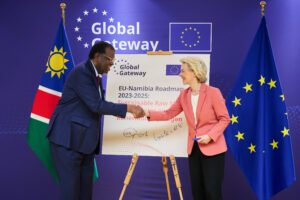
It stands at the forefront of this evolving strategy, representing a key tool in reshaping the EU’s global influence.

The EU’s Global Gateway initiative, launched in 2021, has taken on renewed significance in the current political climate and the mission letter sent by President von der Leyen to the designated Commissioner for International Partnerships. The Global Gateway aims to mobilise up to €300 billion in investments between 2021 and 2027. The stated goals of this ambitious program are to
Read More »
Scroll to Top