

July 9, 2025
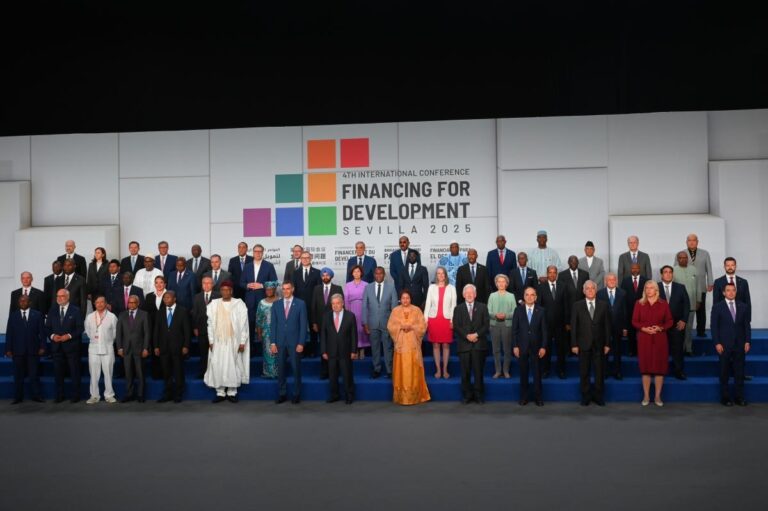
We are now back from the UN Fourth International Conference on Financing for Development (FfD4), held in Sevilla.
Despite the record high temperatures, over 8,000 participants – representing UN member countries, multilateral organisations, the business sector, civil society organisations, think tanks, academia and other experts – gathered and exchanged ideas and policy proposals in more than 470 side and special events. Members of the ETTG co-organised and were involved in many of these.
Attention was in fact drawn to parallel discussions and the SPA (Sevilla Platform for Action) announcements, since the Summit’s conclusions, the Compromiso de Sevilla (Seville Commitment), had already been (pre)approved at UN headquarters a few days before the Summit. This happened after the withdrawal of the US from the FfD4 process – since the country’s proposal of 400 amendments to the draft conclusions was not approved. However, several bolder proposals included in previous versions of the text were substantially watered down throughout the process by both the US and other countries. This was the case, especially, with issues related to the reform of the international financial architecture (IFA), where Bretton Woods institutions play a critical role.
The inaugural addresses revealed the more or less prominent role that countries and supra-national bodies have opted to play. The International Monetary Fund (IMF) recalled its mandate, with no references whatsoever to potential reforms. President von der Leyen presented the EU as the main provider of official development assistance (ODA) despite the ODA cuts announced by key member States; underlined the need for developing countries to mobilize domestic resources; and for the private sector to more actively participate in development processes, making reference once again to the EU’s Global Gateway. Iraq and Angola, on behalf of the G77 + China and the African Group respectively, underscored the importance of multilateralism, the 2030 Agenda, the burden of external debt and the risks posed by geopolitical fragmentation to international and global development.
The conference sent positive signals in some key areas
One of the key topics discussed at FfD4 was how to prevent and resolve debt crises in developing countries (see §§47–51). Despite the multilateral nature of debt, global instruments to avert and handle debt crises are mainly decided upon by institutions such as the International Monetary Fund, the World Bank or the Paris Club, which better reflect the interests of the lenders. Many innovative proposals have been made to solve this, such as establishing an intergovernmental process at the UN to facilitate dialogue between creditors 2
and debtors. Good proposals include establishing a global debt registry and setting up a working group to design and implement new universal principles for responsible lending and borrowing. However, the biggest challenge will be to implement all of these proposals, such as the Borrowers’ Forum, a proposal which is not part of the outcome document but has instead been launched as a SPA initiative. This innovative approach gives heavily indebted countries the chance to coordinate measures and receive technical support for managing their debt. Other promising initiatives include the Alliance for Debt Cancellation Clauses for deferring debt service payments in the event of certain shocks, such as those related to climate change, hence enabling countries to overcome short-term liquidity bottlenecks.
The outcome document states that domestic efforts to mobilise additional public resources must be complemented by “inclusive and effective international tax cooperation” (§26) and capacity support. It underlines that cooperation frameworks must address the specific challenges of developing countries, calling on “development partners to collectively at least double their support to developing countries by 2030” (§27n). UN member states commit to enhancing cooperation to curb illicit financial flows. And they pledge to “support and engage constructively” in the ongoing negotiations of the UN Framework Convention on International Tax Cooperation (§28) – yet another international reform process from which the US has withdrawn this year.
In addition, for the first time the outcome document of an FfD conference contains a reference to tax expenditures. The term refers to the broad range of tax exemptions, incentives, reduced rates and other tax measures that governments use to benefit specific groups, activities or economic sectors. Tax expenditures can be very costly – ca. 4% of GDP or 25% of revenue collection, on a worldwide average – but they are not often effective for attracting private investment. Against this background, the Compromiso de Sevilla states: “We encourage enhanced oversight and management of tax expenditures, including through transparent tax expenditure reporting” (§27).
The outcome document (§30, §33, §37-§40) also emphasises the key role that multilateral development banks (MDBs) and public development banks (PDBs) play in addressing the SDG financing gap – calling notably for MDB’s tripling of their annual lending capacity. Issues relating to “working better as a system” – horizontally and vertically with national development banks -, mobilising additional public and private capital through innovative financial instruments, providing affordable, long-term and, where relevant, local currency financing, responding and contributing to country-led and country owned processes, and better accounting for debt and local fiscal constraints as well as multi-dimensional vulnerability were amongst the key priorities listed. This also calls for the establishment of new country platforms or the strengthening of existing ones.
While this list of commitments does look like a Christmas tree, it provides an anchor for financial institutions to launch key initiatives to help implement the outcome document – which is what matters. In this regard, it is interesting to note that i) over a fifth of action initiatives listed on the platform involves a public development bank as a lead or co-lead; that ii) particular attention was paid to private capital mobilisation (involving and engaging private actors in these conversations), climate resilience, social protection and debt / local currency financing (all areas usually quite disconnected and approached in siloes); and that iii) Global South regional development banks like IDB and CAF are amongst the most active in these action initiatives (showing a change of leadership), and that the World Bank (whose role in multilateralism was the concern of many) also positioned itself as another key supporter of those actions initiatives. 3
The issue of climate finance is substantively addressed in the Compromiso de Sevilla §62-65), which reaffirms the collective commitment to mobilize USD 100 billion annually for climate action (§62), and highlights the need to increase funding for adaptation, especially for Least Developed Countries (LDCs) and Small Island Developing States (SIDS) (§63–64). The text calls for stronger alignment of financial flows with climate objectives, including through multilateral development banks (MDBs) (§65). However, it largely reiterates existing commitments and reaffirms the general importance of aligning finance with climate goals. Transparency in climate finance reporting is another important element in the text (§41b), and was among the issues raised by Global South during the negotiations.
What stands out more clearly in the text is the emphasis on aligning all financial strategies and operations with the SDGs. Beyond general commitments such as launching ambitious reforms to close the financing gap and catalyze large-scale investment for sustainable development in alignment with the SDGs (§6), it underlines the need to align international support with national strategies and frameworks, such as Integrated National Financing Frameworks (INFFs), while respecting each country’s policy space to pursue sustainable development and achieve the SDGs (§8). The text also notes, however, that the presence of these platforms should not be a pre-condition for receiving development assistance (§40a). It also encourages the design of national budgets aligned with the SDGs (§27c), the adoption of results-based financing mechanisms, and improvements in natural resource taxation to support sustainable development (§27). On the private finance side, the Compromiso stresses the importance of promoting policy frameworks that foster an enabling environment for sustainable investment at all levels (§32a), and calls on MDBs to strengthen and align their impact measurement frameworks with the SDGs, to ensure compliance with social and environmental safeguards across all operations (§37h). These are interesting developments, but it will require effective implementation, building on existing experiences and methodologies —particularly those developed by UNDP, the OECD, and within the frameworks of PDBs.
There are other topics that might not be central in the outcome document or in the discussions held in Seville, but that are emerging as potential responses to the challenges of decreasing funds for development and the (sometimes) paralyzing fragmentation of the multilateral system. With just one mention in the Compromiso de Sevilla (§40d) and only one dedicated side-event, total official support to sustainable development (TOSSD) might be one of them. In line with what was stated in the conclusions of FfD4, the discussion at the side-event revolved around the technicalities of making parallel accounting systems more inter-operable (ODA, TOSSD, South-South cooperation), and its political dimension, which is that of greater cooperation among the International Forum on TOSSD, the OECD, UNCTAD and SEGIB.
Commitments on other topics were more difficult
One of the core issues underlying the current trust and legitimacy crisis of the multilateral system is the fact that it was designed by a reduced number of countries. This jeopardises its representativeness and creates systemic inequities in the access to decision-making, and therefore to finance, across countries. This places the reform of the international financial architecture at the top of the Global South’s priorities, who have been demanding a system reform and advocating for certain negotiations to be taken from the IMF and the WB – one dollar, one vote – to the UN – one country, one vote -. 4
In spite of this, the language concerning the reform of the IFA was heavily diluted in the outcome document, partly in response to US pressures throughout the process (before their withdrawal), and especially after their definite withdrawal. Although this has generated disappointment among many, it also signals a determination for the outcome document to remain realistic and not ignore the current context, as no IMF-related reform is feasible without US support, who holds veto power in the institution. Consequently, it is likely that certain conversations will move away from these institutions and to other more representative and operable spaces, such as the G20.
Special Drawing Rights (SDRs) were only briefly mentioned in the 2015 Addis Ababa Action Agenda. But since the 2021 general allocation — crucial in helping developing countries respond to COVID-19 — SDRs have re-emerged as an important tool for development finance and international cooperation. Over $100 billion in SDRs have since been rechanneled to developing countries, and proposals to use them to strengthen MDBs have gained momentum.
Given these developments, expectations were high for SDRs to feature prominently in the FfD4 outcome document. Early drafts reflected this optimism. However, under pressure from major shareholders —likely including but not limited to the US— the final Sevilla Commitment was significantly watered down. While SDRs are mentioned 15 times, the document largely reiterates calls (among others by the Pact for the Future) for wealthy countries to channel at least 50% of their SDRs to developing countries, also through MDBs. More transformative proposals —such as a rules-based approach to future allocations or reviewing the role of SDRs within the international monetary system —were dropped entirely.
SDRs also barely surfaced throughout the conference: the IMF’s Deputy Managing Director didn’t mention SDRs in his speech during the opening session, and just one out of 400 side events focused on them. This mirrors the limited progress achieved in topics related to the IMF more generally, as stated above, partly explained by the US’ veto power in the institution.
The summit conclusion’s statements on Official Development Assistance (ODA) lack a sense of urgency, failed to acknowledge current budget cuts in OECD states (including the state that withdrew from FFD4 altogether), and could have easily been written ten or twenty years ago. Similarly to the contents of the outcome document, ODA was not remarkably present throughout the week in the Sevilla conversations compared to other sources of financing. While ODA is still considered key for its ability to reach certain places and markets – such as fragile settings or as a concessional catalyst of private finance -, there is also a clear conviction that it has to be updated and that the conversation must no longer be just about aid. It is no longer to be considered as a substitute for other financing sources, but rather as a catalyst for capacity building, including for mobilising private capital and public domestic resources.
Noteworthy in this context though was a statement by the Development Assistance Committee of the OECD published on 30 June, whose members announced a “review process to examine the implications of the changing landscape of development finance and of discussions in Sevilla, including for the role of Official Development Assistance (ODA) and of the DAC itself”. While not explicitly referring to the governance of the ODA statistics itself, the review process should allow opportunities to make progress on those ODA governance discussions on which the Compromiso de Sevilla failed to make traction. 5
Some areas that were key in previous conferences on financing for development, such as trade, foreign direct investment and international remittances have been comparatively less prominent in the Sevilla discussions. This is due, on the one hand, to the geopolitical context – an WTO seized for years now, the more recent trade war and escalating tariffs, decreasing FDI stocks and flows – but also, on the other hand, to actual progress in certain areas – such as the substantial decrease in the average cost of remittances’ transfers, especially since the COVID-19 pandemic.
What now?
In light of the crisis of multilateralism and scarcity of resources, countries have opted for minilateralism and coalitions of the willing in order to keep pushing for their shared agendas. The European Commission for instance supported a separate declaration on domestic resource mobilisation. This is probably one of the most important readings from the fact that the Conference not only took place, but that a) states decided to use it to forge new alliances that transcend the level of ambition of the outcome document in certain areas, that b) the business sector has been an active participant all week, and that c) civil society and state actors have found common ground in their shared commitment to prosper.
Beyond the outcome document, the week closed with 130 initiatives already registered at the SPA, which was officially launched on Monday 30 June. Registered initiatives include incorporating pause clauses into debt agreements in case of natural disasters, creating a hub for debt swaps, taxing the super-rich, creating a borrowers’ forum where debtor countries can coordinate and exchange information, or producing a PDBs technical assistance catalogue. These initiatives will allow to hold specific actors accountable for specific goals, and therefore monitor that commitments made become reality.
Far from being an endpoint, Sevilla has kickstarted many necessary and context-aware processes. The much pending work on the different topics will continue. In this regard, some upcoming events to watch will be the General Assembly of the TOSSD International Forum in Spain or the Africa Infrastructure Financing Summit in Angola, both to take place in the fall. The new ‘balance of power’ in the FfD context raises important questions on and expectations for the involvement of the EU and its member states in these upcoming events
Authored by: Iliana Olivié (ETTG / Elcano), María Santillán O’Shea (Elcano), Kathrin Berensmann (IDOS), Damien Barchiche (IDDRI), Karim Karaki (ECDPM), Ben Katoka (IDDRI), Niels Keijzer (IDOS), Christian von Haldenwang (IDOS), Yabibal Walle (IDOS)