
March 2026
As the United Nations marks its 80th anniversary in 2025, discussions about reform are increasingly converging on various structural questions: should the UN remain primarily a forum for global policy coordination, or evolve into a system capable of delivering large-scale reconstruction and infrastructure projects? How to tackle current institutional fragmentation to carry out operational demands, with a more limited fiscal capacity?.
This analysis follows a recent high-level exchange at the UN House between Brussels based think tanks and Jorge Moreira da Silva, Executive Director of UNOPS, where building from the Secretary-General’s public UN80 proposals we explored the practicalities of UN reform, the shifting development finance landscape, and the technical realities of reconstruction in Gaza and Ukraine. The distinction is no longer theoretical, declining aid budgets, rising geopolitical tensions and the scale of post-conflict reconstruction are forcing the multilateral system to reassess how it operates. In this context, a more operational vision of multilateralism is beginning to take shape within parts of the UN system.
Our latest conversations illustrate this shift, rather than positioning the UN primarily as a convening body, this approach emphasises the organisation’s role as a delivery platform: a system able to manage infrastructure, procurement and reconstruction projects in contexts where local capacity is limited and political consensus is fragile. If this trajectory continues, the UN may gradually resemble something closer to a global implementation hub, bridging the gap between political commitments and actual delivery on the ground.
One area where this shift is visible is in discussions around the relationship between UNDP and UNOPS. A technical review currently underway is examining whether closer integration between the two organisations could combine UNDP’s policy expertise with UNOPS’s operational model, which largely operates on a self-financing, fee-for-service basis. The review is expected to report to the United Nations General Assembly by mid-2026.
The broader idea being explored is sometimes described as “Country Team 2.0”: a move away from a fragmented system in which numerous agencies compete for shrinking pools of ODA. Instead, reform discussions increasingly focus on creating more integrated knowledge and delivery hubs, capable of combining policy advice, project management and technical support.
Parallel discussions under UN80 are also exploring possible consolidation between UN Women and UNFPA, although these proposals remain politically sensitive, particularly given concerns about protecting normative mandates in both entities. Even so, the debates themselves reveal a growing recognition that institutional fragmentation is becoming harder to sustain in a context of financial pressure and expanding operational demands.
Crisis response as a test case
The wars in Gaza and Ukraine illustrate how the UN’s operational role is evolving. In Gaza, the immediate focus is not yet full reconstruction but early recovery: restoring electricity networks, water systems and essential services. Rather than focusing on the $70 billion figure often cited for total reconstruction, the current strategy advocates for immediate, technical “micro-budgets” to address urgent local needs. This step-by-step approach seeks to restore basic dignity through verifiable progress:
- The $10 Million Power Strategy: A proposal focused on the rapid rehabilitation of the Gaza power plant. By framing electricity as a neutral “security asset” rather than a political concession, it creates a blueprint for immediate recovery.
- The 2720 Mechanism: This mechanism relies on detailed verification procedures to monitor shipments and address concerns about “dual-use” materials. By using UNOPS engineers as technical auditors, the UN replaces a “trust deficit” with a verification model, maintaining access to sensitive areas where political advocacy has struggled.
- The Rubble Economy: With over 60 million tonnes of debris across Gaza, the plan involves turning a liability into a resource. Industrial crushing facilities could convert rubble into aggregates for road construction and other infrastructure, creating a circular economy in a crisis zone.
In Ukraine, the scale of reconstruction is far larger. According to the latest RDNA5 assessment, recovery and reconstruction needs have reached approximately $588 billion. Immediate priorities include restoring housing, energy systems, and heating infrastructure, alongside extensive demining operations – now estimated to cost nearly $28 billion.
Key figures
| Indicator | Gaza | Ukraine |
| Estimated reconstruction needs | ~70 billion (est. Oct 2025 / Feb 2026) | ~588 billion (RDNA5, Feb 2026) |
| Main immediate priorities | Water, electricity and fuel supply | Housing, heating and energy systems |
| Key structural challenge | Debris removal: approx. 60 million tonnes of rubble (incl. UXO / asbestos) | Landmines: world’s most heavily mined territory |
| Demining requirements | Significant, still under assessment | ~28 billion estimated for full clearance |
| Governance mechanisms | UNSC Resolution 2720: audit‑style humanitarian verification | Multi‑donor recovery coordination frameworks |
Sources: Gaza figures – UNOPS Operational Updates (Jan 2026) and the UN 2720 Mechanism; Ukraine data: Joint RDNA5 Assessment (Feb 2026) and the DREAM Digital Recovery Portal.
For European policymakers, these developments intersect with debates about how to operationalise initiatives such as the Global Gateway. A recurring problem in development finance is the disbursement gap, while the financing gap for achieving the SDGs is estimated at roughly $4.2 trillion annually, many countries struggle to translate available funding into functioning projects. In some contexts, disbursement rates remain around 30 per cent, reflecting limited technical capacity, procurement challenges and governance constraints.
In practice, this is precisely the space where operational UN agencies often intervene; by managing procurement, engineering oversight and project implementation, organisations such as UNOPS can reduce risks for donors working in fragile environments. For Europe, this raises an important possibility: the UN system could increasingly serve as a technical implementation partner for infrastructure and reconstruction initiatives where direct investment remains difficult.
A quieter transformation
The most significant change underway in the UN system may therefore be less visible than large diplomatic initiatives. Rather than redefining global governance through new treaties or institutional structures, the organisation may be gradually evolving through its operational functions.
In an international environment marked by political polarisation, traditional consensus-driven diplomacy is often slow and contested. Reinforced technical cooperation, infrastructure delivery and reconstruction projects may offer a more pragmatic path forward. By evolving into a functional bridge between high-level policy and ground-level implementation, the organisation can translate fragile diplomatic consensus into the tangible infrastructure of peace and recovery.
If the UN’s reform discussions ultimately lead in this direction, its future legitimacy may depend less on its ability to produce declarations and more on its capacity to deliver practical outcomes where they matter most.
Authored by: Mariana Camelo (ETTG), with inputs from Daniele Fattibene (ETTG)
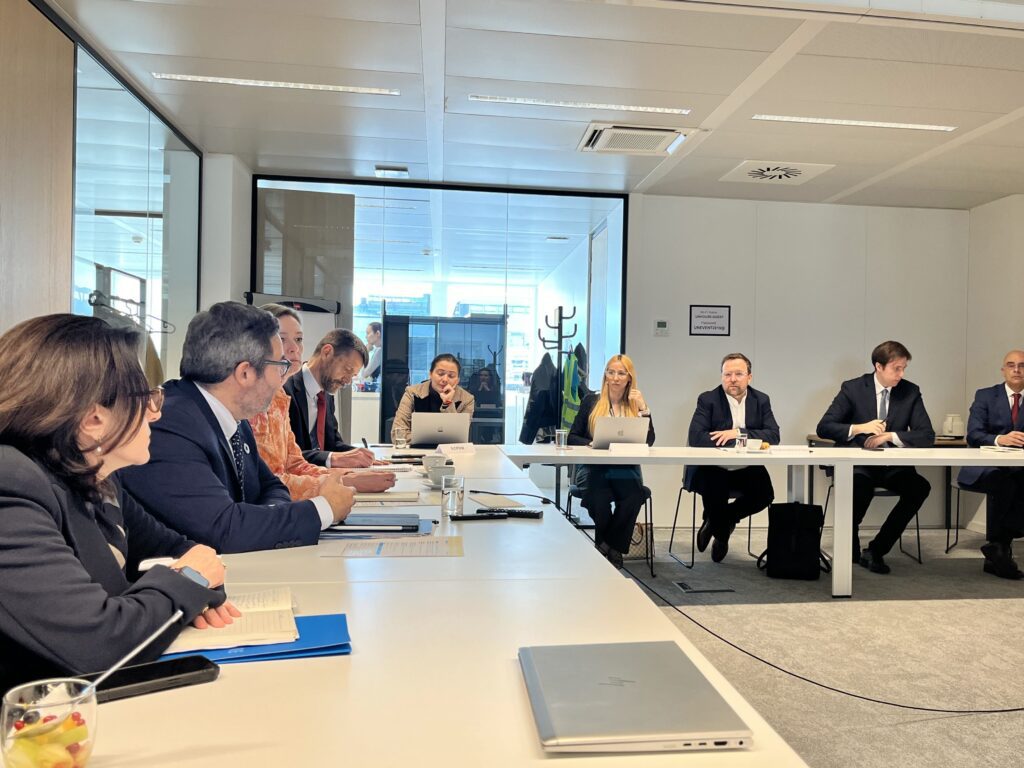
Picture of Meeting with Brussels Based Think Tanks by: @UNOPS