
Over the past two years, with the support of Stiftung Mercator, we have examined how Europe and Africa can construct more equitable, interest-driven digital partnerships within an increasingly fragmented global order.
As digitalisation continues to redefine international development, this initiative convened experts, researchers, and policymakers across three continents to address the structural trade-offs, security vulnerabilities, and collaborative frameworks that shape intercontinental cooperation. Operating within a multi-crisis context-marked by institutional instability in the Sahel and shifting geopolitical alignments, the project sought to move beyond traditional donor-recipient dynamics toward a balanced partnership of equals.
The initiative has culminated in a body of evidence-based analysis, exploring how digital public infrastructure and technological governance intersect with continental stability.
Our complete research portfolio and tracking data are now accessible on the project page : https://bit.ly/4au3epA
Key Outputs and Institutional Reach
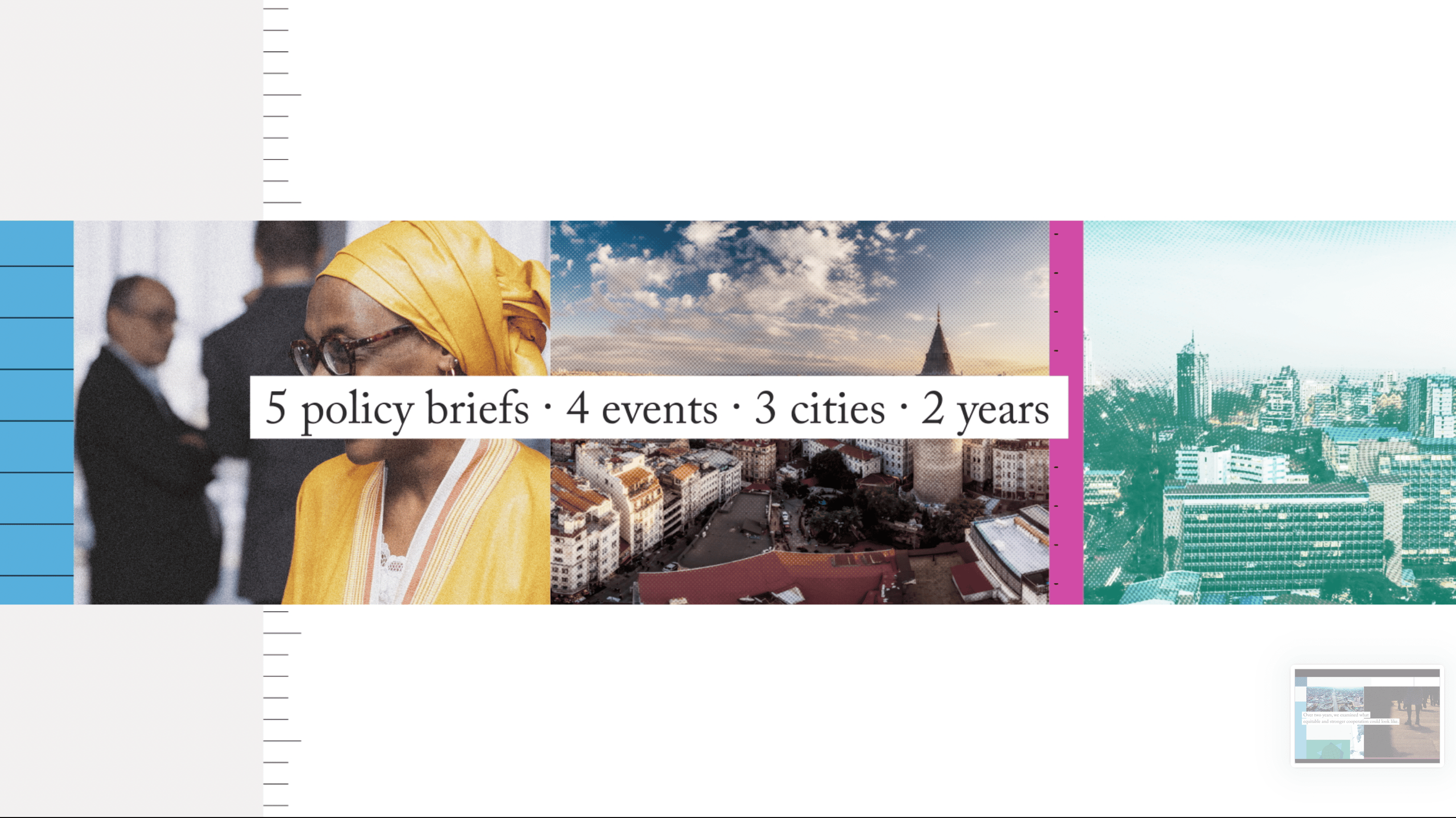
- 5 Policy Briefs delivering targeted analytical frameworks on the deployment of artificial intelligence in electoral administration, the mitigation of digital disinformation, the scaling of EU-AU cyber security cooperation, and the strategic operational alignments between the EU Global Gateway and Italy’s Mattei Plan.
- 4 High-Level Events convened in Accra, Marrakech, and Istanbul, bridging public policy panels with closed-door expert roundtables to evaluate the comparative development strategies of the EU, Turkey, and China.
- 22 Dedicated Newsletters systematic distribution of real-time insights, policy monitoring, and research findings to international stakeholders.
The research focused on the nexus between digital transformation and institutional resilience, identifying three primary entry points for enhanced EU-AU alignment.
1. Democratic Integrity and Information Security
The research examined how emerging technologies alter the structural security of democratic processes. In evaluating artificial intelligence for electoral administration, the analysis demonstrated that while automated data entry and biometric verification optimize operational efficiency, they simultaneously introduce profound vulnerabilities regarding data sovereignty and algorithmic bias.
These technical challenges are compounded by the cross-border proliferation of digital disinformation. High-level dialogues in Accra and Rome highlighted that countering foreign information manipulation requires robust interagency collaboration. This involves aligning the European Union’s digital regulatory playbook with African electoral management bodies to safeguard critical infrastructure without compromising civic space.
2. Strategic Infrastructure and Geopolitical Complementarity
A core focus of the project’s later publications was the operational synchronization of European investment instruments. The analysis evaluated the potential for synergetic alignment between the EU Global Gateway investment package and Italy’s newly deployed Mattei Plan.
The findings indicate that to achieve inclusive growth, international cooperation must prioritise bridging foundational infrastructure gaps, specifically access to electricity and secure localized data centers. By linking European regulatory expertise with targeted capital deployment, the partnership can establish a values-based digital single market capable of navigating intensive global competition from alternative external models.
3. Security-Development Architecture in Trans-Regional Crisis
The project addressed the realities of diplomatic engagement in regions experiencing constitutional crises, notably the Sahel. The policy outputs emphasize that rebooting EU-AU relations requires a transition from punitive measures to sustained strategic patience.
Evidence indicates that blanket sanctions often exacerbate civilian poverty and weaken local development structures, ultimately undermining long-term digital and economic connectivity. The project recommends that both the EU and African Union adopt integrated peace-security-economic initiatives. These must maintain open channels of communication with transitional authorities to prevent regional fragmentation and build institutional resilience against systemic shocks.