
November 2026
Twenty-five years after the inaugural Cairo Summit, the Africa-EU relationship has reached a structural inflection point that traditional donor-recipient paradigms can no longer navigate. Both continents now operate as middle powers within an increasingly fragmented, multi-aligned global order, where building genuine resilience requires a hard-nosed, interest-driven collaboration rather than diplomatic complacency. Drawing on multistakeholder dialogues convened in Rabat by the European Think Tanks Group and the Policy Center for the New South, this collective report interrogates the fault lines and strategic complementarities across three core pillars: mobility, security, and industrial transformation.
The narrative surrounding migration between the two regions remains heavily skewed by political polarisation and security-driven rhetoric. In reality, over 80% of African mobility occurs within the continent, whilst African-born migrants residing globally represent only around 3% of Africa’s total population. The underlying demographic structural shift could not be starker: Europe faces a median age of roughly 43 to 45 years and chronic labour shortfalls in healthcare, information technology, and construction, while Africa’s median age is just 19, with nearly 70% of the population under 30. By 2030, half of all newcomers entering the global labour force will originate from sub-Saharan Africa, necessitating the creation of 15 million new jobs annually. Yet between 2014 and 2024, a mere 11% of European work permits issued to foreign workers went to Africans, deterred by heavy consular friction and the lack of cross-border qualification recognition. Shifting towards co-financed Global Skills Partnerships that train for both domestic African and European markets, backed by ethical safeguards against brain drain in sectors facing steep shortages, offers a pragmatic economic solution.
A parallel reassessment is overdue across the security architecture. African military expenditure climbed to 58.2 billion dollars in 2025, an 8.5% year-on-year increase and a 45% surge since 2016, yet regional stability across the Sahel, the Lake Chad Basin, and the Great Lakes continues to degrade. Relying purely on kinetic intervention fails to tackle the structural drivers of conflict, which include governance deficits, climate disruption, and illicit mineral supply chains funding armed groups. Recent trends show that external security force assistance can even unbalance civil-military relations and entrench military rule. Furthermore, European reliance on ad hoc bilateral defence pacts and mechanisms like the European Peace Facility risks fragmenting the multilateral authority of the African Peace and Security Architecture. A sustainable recalibration requires diverting resources into non-kinetic peacebuilding, institutional integrity, supply chain traceability, and maintaining non-political diplomatic channels with transition authorities rather than pursuing counterproductive diplomatic isolation.
On the economic front, both continents are rewriting industrial priorities around clean transformation and resource security. With over 20 African nations pursuing green industrialisation policies and the EU accelerating its Net-Zero Industry Act and Critical Raw Materials Act, interests visibly converge. However, translating ambition into outcomes faces severe hurdles: navigating the zero-sum dilemma between European resource demand and Africa’s push for domestic processing and battery value chains; resolving trade frictions created by the Carbon Border Adjustment Mechanism; overcoming domestic infrastructure deficits where daily 10-to-14-hour load shedding hampers capital-intensive processing; and competing directly against Chinese actors who control an estimated 80% of mining assets along key logistics arteries such as the Lobito Corridor.
An enduring partnership cannot be grounded in the illusion that every initiative yields a friction-free, win-win outcome. It demands shared definitions of industrialisation and criticality, administrative simplification, and a deliberate move from isolated pilot schemes to cross-border investment pipelines.
Coordinated by Iliana Olivié and Daniele Fattibene, with contributions from Adrien de Bassompierre, Ayman Adel, Damien Barchiche, Darlington Tshuma, Despoina Damianidou, Dora Meredith, Elisabeth Hege, Ettore Greco, Hamza Saidi, Ibrahima Kane, Inès Auriol, Inge Poelemans, Isabelle Ramdoo, Jeggan Grey Johnson, Jessica Hagen Zanger, Jide Okeke, Jolita Pons, Julian Bergmann, Karim Karaki, Linda Oucho, María Santillán O’Shea, Mariana Camelo, Mariem Dkhil, Marta Driessen, Nargis Kassenova, Niels Keijzer, Nouzha Chekrouni, Rim Berahab, Roslyn Ng’eno, Sabrine Emran, San Bilal, Sebastien Treyer, and Veronica Bolton Smith.
The fourthcoming report will delve into the institutional roadmaps, policy instruments, and relevant sectoral analyses.
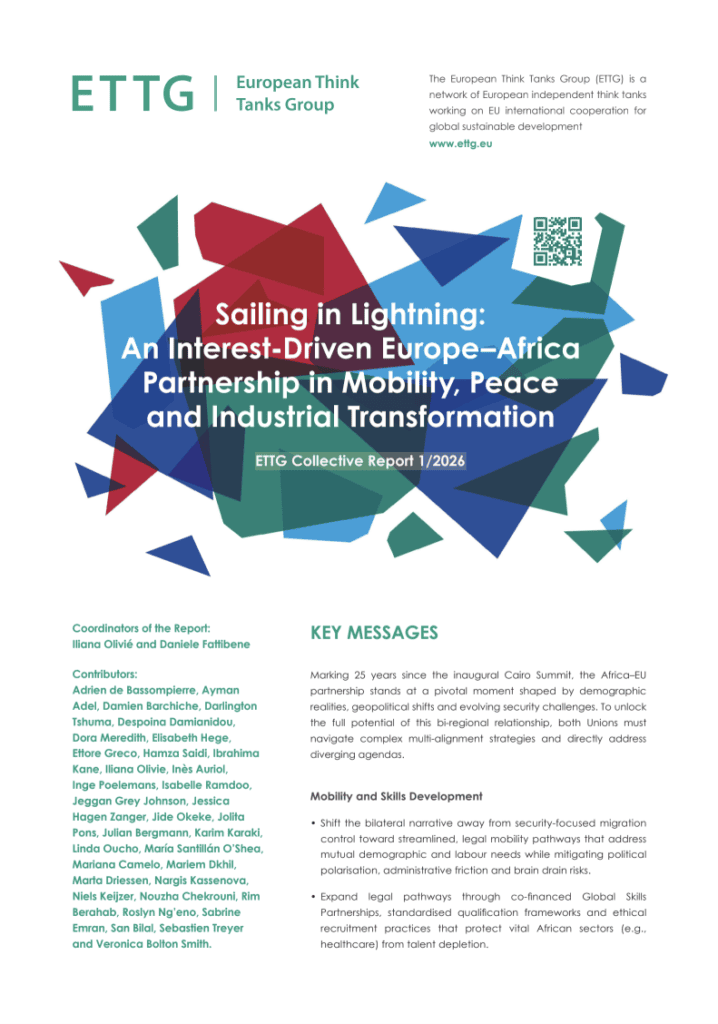
Image Source: EC – Audiovisual Service, European Union , 2025